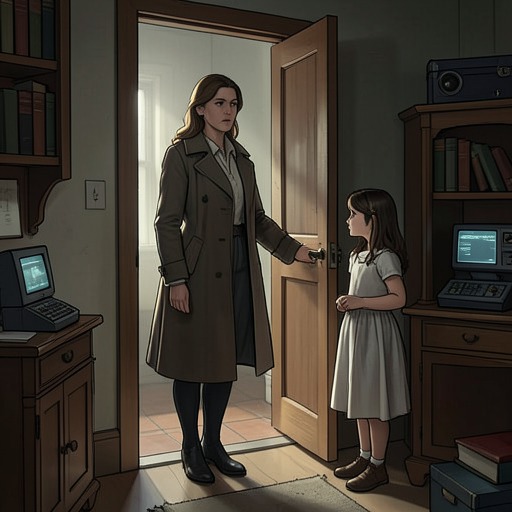
Mariko
A Pale View of HillsMariko, Sachiko’s young daughter, is wary of adults and difficult to reassure. Her recollections of a woman in Tokyo, her repeated questions about her mother’s absences, and her insistence that Sachiko honor a promise about the kittens reveal a child caught between what she has witnessed and what her mother expects her to accept. In Etsuko’s account, Mariko’s silences and watchfulness make her experience legible without resolving all its uncertainties.
Identity and Introduction
Etsuko first presents Mariko through an encounter with Sachiko: she reports that the child has been fighting two other children, including a boy, near the ditches. The brief report establishes that Mariko’s life includes conflict beyond the strained exchanges at home, but it gives no explanation for the fight. Mariko is not introduced through a full account of her circumstances; instead, the reader learns about her in fragments, often as Etsuko tries to understand what she has seen or heard.
Mariko is Sachiko’s daughter and is present in the cottage where Etsuko visits them. Her interactions suggest both guardedness and a desire for dependable attention. When Etsuko reminds her that she once invited her over while Sachiko was away in town, Mariko distinguishes Etsuko from another woman, whom she says came to the cottage the previous night. That woman, Mariko explains, offered to take her home, but Mariko refused because it was dark. She points to the lantern as the means the woman had proposed using. The specific object anchors a troubling account in ordinary surroundings, while Mariko’s explanation remains matter-of-fact.
The Woman Mariko Saw in Tokyo
Sachiko later identifies the woman Mariko keeps talking about as someone Mariko saw in Tokyo. Sachiko recalls that Mariko ran away one morning and that she followed her through an alley to a canal. There, a thin young woman was kneeling in the water with a baby. The woman turned toward Mariko and smiled, then showed them the baby she had been holding beneath the water. Sachiko took Mariko away from the scene. She says the woman later died by suicide, but also stresses that she never knew her. The account gives a concrete source for Mariko’s recurring image while leaving her exact understanding of what happened unstated.
Mariko’s account of the woman at the cottage and Sachiko’s account of the woman by the canal are not identical episodes: one concerns a visitor who offered to lead Mariko away; the other is Sachiko’s recollection of what Mariko witnessed in Tokyo. Their connection lies in the woman’s repeated presence in Mariko’s telling. The narrative does not establish whether Mariko confuses the two women, associates them, or is describing a further encounter. That uncertainty matters: her memory is persistent, but the adults around her do not give it a settled explanation. Etsuko’s recollection preserves both Mariko’s insistence and the limits of what she can know.
Sachiko and Mariko
Mariko’s need for her mother’s attention emerges sharply when Sachiko insists that she stay and apologize to Etsuko. Sachiko gives her a physical reprimand, and Mariko’s eyes fill with tears. Rather than simply comply, she asks why Sachiko is always going away. The question shifts the moment from a dispute over manners to the recurring absence Mariko experiences. Sachiko raises a hand warningly, but the exchange offers no answer to the child’s question.
On another evening, Mariko imagines that the kittens can all be kept if they are taken in a box. Sachiko agrees, laughing, and the prospect appears to become a promise in Mariko’s mind. On the tram home, Mariko presses her forehead to the window and remains silent while Etsuko and Sachiko speak little. Etsuko later recalls that face in the changing city lights. The contrast between the child’s hopeful proposal and her silence on the journey gives the episode its emotional weight without making her thoughts explicit.
The Kittens and the Broken Promise
As Sachiko packs at the cottage, Mariko asks whether she has decided what will happen to the kittens. Sachiko says they cannot discuss it because she is busy. Mariko reminds her that she had been told she could keep them. When Etsuko offers to feed them until homes are found, Mariko repeats that her mother promised she could keep them. Sachiko dismisses the matter and begins putting the kittens into a vegetable box. Mariko still holds one when Sachiko tells her to hand it over. The disagreement is not merely about where the animals will go: Mariko is asking her mother to make an earlier assurance count, while Sachiko treats the promise as an inconvenience amid her preparations.
Sachiko subsequently takes a kitten from the box and places it in the water, then returns it to the box, remarking on the dirty water and the animal’s struggle. Mariko watches from the top of the slope, her expression blank and her hands behind her back. When Sachiko looks over her shoulder, their eyes meet briefly; Mariko makes a slight movement of her head and remains still. The scene brings the earlier promise into direct conflict with Sachiko’s actions, but Mariko does not answer with another argument or visible protest. Her stillness leaves the consequence of the exchange open while making her presence as witness unmistakable.
Narrative Role
Mariko’s account is mediated through Etsuko’s recollection, which repeatedly sets adult explanations beside details that remain unresolved. Sachiko supplies an account of the woman in Tokyo, but Mariko’s own report of a visitor at the cottage cannot simply be folded into it. Likewise, the promise about the kittens is remembered and repeated by Mariko, then contradicted by what Sachiko does. Across these episodes, Mariko’s insistence is clearest where the adults’ accounts and actions fail to provide security: she remembers the woman, asks why her mother leaves, and holds on to what she was told about the kittens. The narrative gives her no final explanation or resolution in these scenes; instead, it makes her silence and close attention part of the evidence through which Etsuko’s past is recalled.